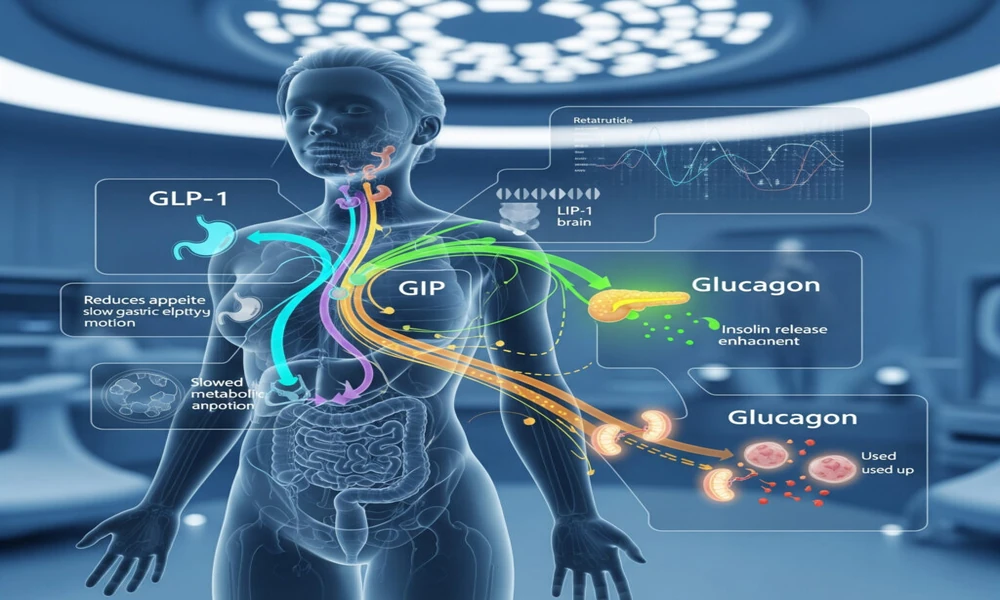
What is the incretin system?
Standard endocrine signals are not affected by incretin hormones. The insulin response to GLP-1 and GIP changes based on how much glucose is present, rather than triggering at a fixed rate. Scientists initially underestimated the extent to which GIP reaches fat tissue. Retatrutide was built around both receptors, and that starting point is what connects it directly to incretin biology. Scientists tracking where to buy retatrutide online for structured preclinical acquisition noted early that engaging both incretin receptors together produced a compounding signal neither hormone created alone.
Slows gastric emptying and reduces appetite with GLP-1. As well as increasing insulin output, GIP targets adipose tissue as well. The retitrutide pathway does not choose between them. When both are delivered simultaneously, the body receives different messages than if a single receptor agonist is delivered.
How does retatrutide use incretin pathways?
GIP and GLP-1 receptor activation under retatrutide’s profile do not simply add together. GIP receptor engagement in fat tissue increases fatty acid uptake during fed states. When GLP-1 receptor activation runs concurrently, pancreatic insulin response sharpens because both signals converge on beta cell output. GLP-1 also suppresses glucagon from alpha cells, cutting hepatic glucose release between meals. Researchers studying this combination found that energy intake dropped further than that produced by GLP-1 receptor agonists alone. Fat oxidation accelerated beyond what either incretin generated independently. Dual incretin engagement recalibrates how efficiently the body distributes energy rather than simply reducing intake. That recalibration is what separates retatrutide from compounds that work through one receptor, and it surfaces consistently across metabolic endpoints in controlled research environments where incretin contribution is tracked separately from glucagon receptor effects.
Glucagon receptor and incretin balance
Glucagon sits outside the incretin category, but it intersects with incretin function at multiple points. GLP-1 suppresses glucagon secretion, which would normally limit hepatic fat oxidation if glucagon receptor activation were absent. Retatrutide holds both simultaneously. GLP-1 prevents glucagon from raising blood glucose without restraint, while glucagon receptor engagement continues accelerating fat breakdown and thermogenic output. Researchers describe this as a controlled tension rather than a contradiction. Incretin pathways supply the insulin-sensitising and appetite-modulating base. Glucagon receptor activation layers metabolic acceleration over that base in a way neither incretin hormone can produce on its own. Preclinical data confirmed that the ratio of receptor engagement across all three targets in retatrutide’s profile determines how the body directs energy between storage and active expenditure across observation periods.
Research focuses on triple agonism
Dual incretin agonists demonstrated fat tissue and liver effects that single-receptor compounds consistently missed, which expanded the research appetite for adding glucagon receptor targeting. Retatrutide entered that space and investigators built protocols that measured each receptor’s contribution individually. Removing either incretin receptor from the profile weakened the overall metabolic signal in a measurable way. Full triple engagement produced the most consistent outcomes across lipid, glucose, and body composition endpoints, regardless of cohort variation.
Incretin biology gave retatrutide its structural rationale from the start, but glucagon receptor inclusion is what made it a genuinely distinct research compound rather than a modest refinement of incretin-based peptides that preceded it in metabolic investigation.